form:

The Meaning of εξουσιαι - "the Powers that be"
The Bible, when read from cover to cover, is an anarchist manifesto. Romans 13, in context, shows "the State" to be of demonic origin and character. The chapter begins by saying
"Let every soul be subject to the higher powers"
The phrase "higher powers" is sometimes translated "governing authorities," which has the connotation of "legitimate guardians of the peace, wise, benevolent, foresighted, public servants, and community-minded leaders." Or something like that. Rah.
But in the Bible, "the powers that be" are dark, menacing, evil, and malevolent. And "the State" is the product of evil, depraved rebels against the reign of God.
What Romans 13 says (continuing the thought from the previous chapter, Romans 12) is that we are not to resist evil. We are to overcome evil acts, chaos, and tyranny with good deeds, peaceful order, and service.
Here's a website that allows you to search for Greek words in the New Testament. Here are the results for a search of the Greek word in Romans 13:1, "εξουσιαι," "powers" (plural):
| Base form: |
|
| Number: | plural |
| 2. | Romans 13 |  |
1 Let every soul be subject unto the higher powers. For there is no power but of God: the powers that be are ordained of God. |
| 3. | Ephesians 3 |  |
10 To the intent that now unto the principalities and powers in heavenly places might be known by the church the manifold wisdom of God, |
| 4. | Ephesians 6 |  |
12 For we wrestle not against flesh and blood, but against principalities, against powers, against the rulers of the darkness of this world, against spiritual wickedness in high places. |
| 5. | Colossians 1 |  |
16 For by him were all things created, that are in heaven, and that are in earth, visible and invisible, whether they be thrones, or dominions, or principalities, or powers: all things were created by him, and for him: |
| 6. | Colossians 2 |  |
15 And having spoiled principalities and powers, he made a shew of them openly, triumphing over them in it. |
| 7. | Titus 3 |  |
1 Put them in mind to be subject to principalities and powers, to obey magistrates, to be ready to every good work, |
| 8. | 1 Peter 3 |  |
22 Who is gone into heaven, and is on the right hand of God; angels and authorities and powers being made subject unto him. |
| There is one passage that seems less clearly demonic: Luke 12:11. Closer analysis shows the Satanic connection: | |||
| 1. | Luke 12 |  |
11 And when they bring you unto the synagogues, and unto magistrates, and powers, take ye no thought how or what thing ye shall answer, or what ye shall say: |
Greek New Testament - Univeristy of York
"The rule of the Roman Empire was the simultaneous integrated endeavor of spiritual and human authorities. In Pauline literature 'authorities' (exousiai, including the singular used in such a way as to indicate a plurality, i.e., 'every authority') is consistently used to refer to the spiritual powers" (Clinton Morrison, The Powers that Be: Earthly Rulers and Demonic Powers in Romans 13.1-7, p. 25).
For the earliest generations of Christians, Rome was not just a neutral human government. It was animated by demonic powers — fallen angels, “principalities and powers,” or “idols” given life by demons.
Justin Martyr (2nd c.)
In the Second Apology (5), he describes the demons as having inspired the persecution of Christians through Rome:
“The evil demons … stirred up men who are called philosophers … and they also excited the Roman emperors to issue decrees against us.”
Tertullian (c. 160–225)
In Apology 12, he says the worship of Roman gods is really the worship of demons:
“What you call gods we know to be demons.”
Rome’s power and cult were demonic in origin.
Origen (c. 185–254)
In Contra Celsum (Book VIII), Origen affirms that Rome’s idolatry and persecution of Christians are energized by demons. For him, behind every earthly power is a hierarchy of angels or demons — Rome is under the sway
of the latter.
Lactantius (c. 250–325)
In Divine Institutes (Book II), he says the Roman gods are demons leading men astray, and Rome’s imperial violence stems from that allegiance.
Augustine (354–430)
In City of God (Books II and XIX), Augustine writes that Rome, despite its grandeur, was enslaved to the worship of demons:
“The gods of the nations are demons” (citing Psalm 96:5 LXX).
He interprets Rome’s “virtues” as actually vices stirred up by demonic pride. Rome is “glorious” in the earthly sense, but in reality it is a demonic counterfeit of the true City of God.
So, early Christians did not hesitate to take the NT’s language of archai and exousiai literally as demonic powers at work in and through Rome.
Modern scholars (esp. Berkhof, Wink, Yoder, Elliott, Horsley, etc.) often reinterpret these terms more sociologically:
The “powers” are structures and institutions (political, economic, military) that are good in creation but become fallen and oppressive.
Rome’s rule is explained in terms of social domination systems, not necessarily literal demons.
This is sometimes called a “de-mythologized” or “structural” reading of the powers.
Difference in emphasis:
Early writers: Rome = a demonic empire, literally under spiritual beings.
Modern writers: Rome = an oppressive system, metaphorically (or structurally) demonic.
The language overlaps, but the ontology is different: literal demons vs. structural critique.
Continuity: Both ancient and modern agree Rome was more than “just politics” — it was spiritually charged.
Discontinuity: The early Christians assumed real demons animated Rome’s politics; many modern interpreters see “demons” as symbolic of systemic injustice or institutional evil.
✅ Summary:
Early Christian writers generally saw Rome as literally animated by demons, consistent with their reading of the NT “powers.” Modern writers often reinterpret that in structural or sociological terms, making the demonic
dimension metaphorical. The shift is from ontological (real spirits behind the empire) to sociological (oppressive structures named with spiritual language).
There is something mysterious about demonic activity in the first century. Some preterist writers have suggested this demonic activity ended at the coming of Christ culminating in AD 70. But even if the preterists are wrong, there is still something to learn about submitting to demonic forces, even Satan himself. This submission/respect mandate does not confer moral legitimacy on "The State." In fact, I think it undermines it.
Titus 3:1 - Put them in mind to be subject to principalities and powers, to obey magistrates, to be ready for every good work - seems to be talking about both the human archists and the demonic forces controlling them.
Jude 1:9 - Michael the archangel did not blaspheme the devil himself (βλασφημία (blasphēmia)
2 Peter 2:10 - criticizes those who "do not tremble as they blaspheme the glorious ones" (ESV). "Glorious" is not the same word, but may be the same theme as the "higher powers" of Romans 13:1.
The fact that Paul commanded his readers to "be subject" to Caesar (Romans 13:1) does not contradict the claim implicit in that same verse that Caesar was animated by demonic powers. Why would anyone want to signup with a demonic enterprise like "The State?"
This is a book-length website. Here are some pages which dig deeper into the background and meaning of Romans 13. They explore God's sovereignty over evil, the work of angelic beings in the Providence of God, and the necessity of abolishing evil in the world, especially the State. These are the lost themes of Romans 13.
We recommend reading them in the order below. The first three pages are foundational. The first page helps us cultivate the heart of a servant and Christian non-archist. The second page is critical to understanding Romans 13, and the reader is urged to spend some time perusing the rest of the pages on that site ("TOTAL Predestination"), particularly the pages on "Baalism" and "Radical Calvinism."
- Pray for a Servant's Understanding of Romans 13
- All Evil is Predestined by God
Reading all these verses puts Romans 13 in a completely new context.- Christian "Anarchism" is Our Goal
For those who would like more detail, especially on the cultural background of Romans 13, the following are useful. These essays were written back in the early 1980's, and have not been revised since. We're counting on the reader being delayed by those first three pages (above) long enough for us to get the rest of these pages edited and revised. As you will discover, there are very few original thoughts on this website. Nearly all our ideas are plagiarized from other writers: Reformed, Dispensational, and even secular. Our contribution is putting them all together for the first time.
- Angels and God's Throne of Government
Providence - God Governs through Angels- Stars and Idolatry
God Governs the Evil through demons- Why the State Always Encourages Immorality
Theft, murder, vengeance, fraud, sexual immorality- Unlucky 13 -- Romans 13, Revelation 13 and Isaiah 13
Isaiah 13 and Revelation 13 say the same thing as Romans 13
The State is evil, but God is sovereign over it.- A Roman's-Eye View of Romans 13
• The State: The Religion of Man
• The Liturgical State
• The Supernatural State
• The Syncretism of the Universal State
• The Greco-Roman Background
• Views of Babylon, Egypt
• Main Currents in Greco-Roman Statism
• Power (dunameiV, dynameis)
• Astrology
• Monotheism- "Principalities and Powers" - Part One: The Old Testament
• Judaism vs. the Bible
• The Spirit World of Judaism
• Deuteronomy 32:8
• Daniel 10- "Principalities and Powers" - Part Two: Powers in the New Testament
• German Liberals and Conservative Protestants
• Lords Many and Powers Many
• Exousiai is plural- Lakes of Fire in "Smoke-Filled Rooms"
• "Demons" (daimones, daimoneV)
• Pagan Demonology
• Christian Syncretism- Romans 13: The Burden is on the Archists
• Romans 13 is Not a Starting Point
• God's Law is Our Starting Point
• The State vs. the Family: Monopolization of Powers
• Why the Decline of Patriarchal Power?
• If the State is "Ordained," How Can it Be Judged?- Taxation, "Consent of the Governed," and the Myth of the State
• The Myth of "Representative Government"
• Taxation and Biblical Law - Can the State tax too much?
• Taxation and "Representation" - Did Christians in Paul's day enjoy representation?
• Consent of the Self-Governed- Why the State is not a "Divine Institution"
• Some Kind of "Christian Anarchism"?
• The State and the War of the Powers Against Supernatural Government
• The State after Nimrod- Angels and Autarchy
• Angelic Government Before the Cross
• Autarchy and Anarchy
• Angels Watching Over Me
• The Church's Witness to the Angels
From our "95 Theses on the State"
The Origin of "the State" ("Civil Government") - Political Philosophy 101 According to the Bible
Yeah, that rhetoric is possibly a bit off-putting.
HowToBecomeAChristianAnarchist.com
Famous Archists in History: |
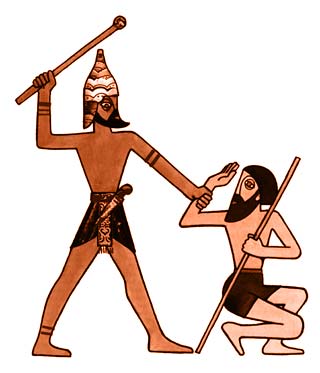
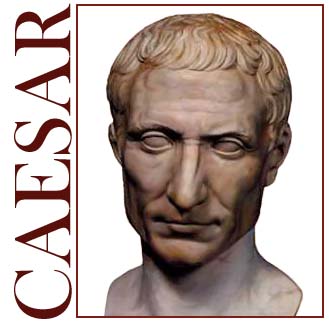
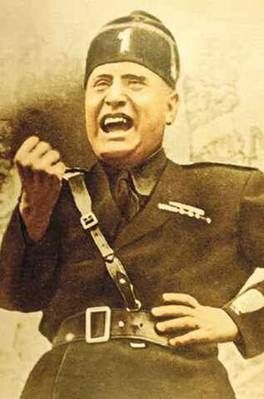
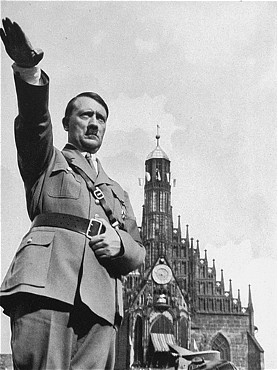
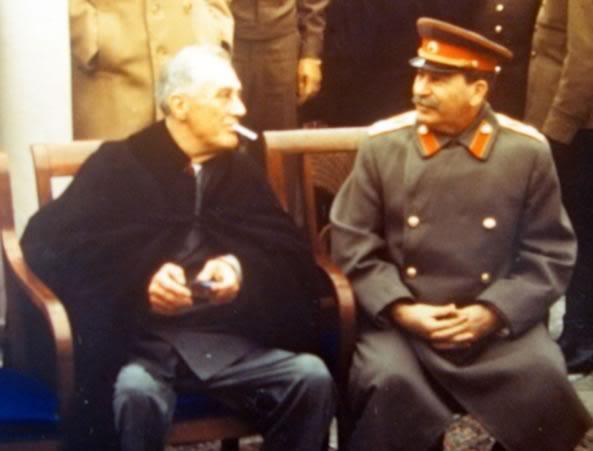

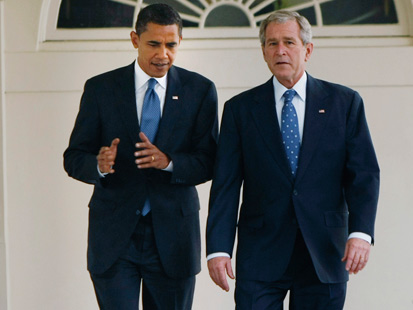
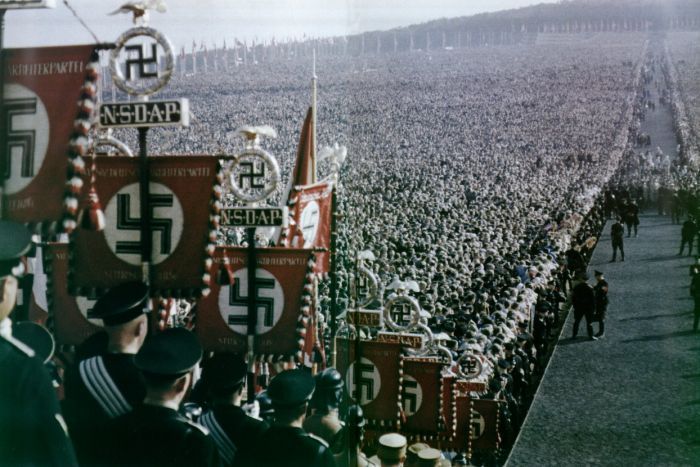
You'll recognize one of those archists above as Adolph Hitler.
Hitler did not kill six million Jews.
Name one Jew whom you can prove Hitler killed.
Six million Jews were killed by
six million Germans
who chose to wear a silly uniform, walk a silly goose-step, and follow the orders of a beyond-silly, pathologically evil man.These Germans were archists. They were "ordinary people." Just like you.
|
If you don't take immediate steps to become an anarchist, then by default you'll be an archist. Plus, you'll be unable to resist the temptations, the bribes, the pressure and the threats by archists to become an archist. You'll become an archist just like those rows and rows of "good" Germans above. They are just like you. You are just like them. "Sensible." "Rational." "Practical." |